Management Procedures of the Campfire – Extinguishing the Fire
At the end of every Forest School session, the campfire must be completely extinguished before the group leaves the fire area. The fire triangle can be used to explain how a fire can be extinguished by removing fuel, heat or oxygen.
Removing the Fuel – The fire should be allowed to burn down naturally towards the end of the activity. No additional fuel should be added once the session is coming to an end.
Any remaining larger pieces of wood can be allowed to burn down. Where appropriate, they can be carefully moved within the fire bowl so that they burn down safely. The aim is to reduce the amount of burning fuel before beginning to extinguish the fire.
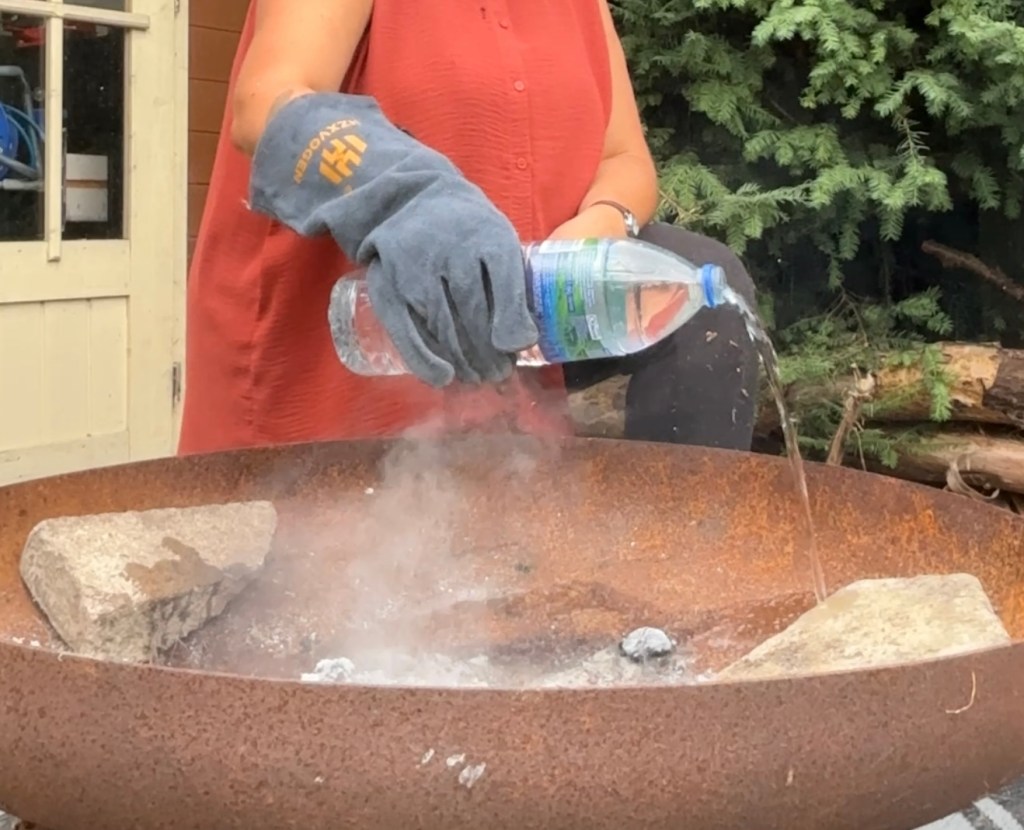
Removing the Heat – Water is used to cool the fire and remove the heat from the remaining embers.
As we use small, controlled Forest School fires, I pour water carefully in a circle around the outside edge of the fire and gradually work towards the centre. This allows the fire to cool progressively and reduces the risk of disturbing hot embers.
The water is added carefully while the fire is gently stirred so that it reaches all of the embers. This process is repeated until there is no longer any steam, hissing or visible heat.
Removing the Oxygen – Once the fire has been thoroughly cooled and there are no remaining hot embers, soil can be used to cover the remaining material if appropriate. This helps to remove the oxygen supply and reduces the possibility of any remaining ember reigniting.
The fire should not simply be covered while it is still hot, as it may continue to smoulder underneath the soil or sand.
Checking That the Fire Is Extinguished
The fire should never be assumed to be out just because there are no visible flames.
I carry out a final check by carefully stirring the ashes and embers to identify any hidden hot spots. I check for:
- Glowing embers
- Smoke or steam
- Heat remaining within the fire bowl
- The surrounding ground has been checked for escaped embers.
- All cooking equipment and fire-lighting equipment has been safely removed.
- The fire area has been left clean and safe.
The final responsibility for confirming that the fire is fully extinguished remains with the Forest School Leader.
Teaching Students How to Extinguish a Fire Safely
I would introduce fire extinguishing as part of the students’ learning about the fire triangle. I would explain that, just as a fire needs heat, fuel and oxygen to burn, removing one or more of these elements will extinguish it.
I would demonstrate the process first, explaining each stage clearly and using simple language. Students could observe the changes as water is added and see how the glowing embers disappear.
Students can be involved in appropriate parts of the process depending on their individual ability, confidence and understanding. For example, they could observe checking the fire, identify whether an ember is still glowing or help collect equipment. More experienced students could support with safe parts of the extinguishing process under direct adult supervision.
Before beginning, I would make sure the group is calm and ready and remind students of the fire safety rules. Students should remain in their designated positions unless invited to approach the fire.
I would use repetition and the same routine at the end of each fire session so that students become familiar with the process. This helps students develop an understanding that the responsibility for a fire does not end when the flames go out – the fire must be completely cold before the site can be left.



Leave a Reply