Maslow’s Hierarchy of Needs
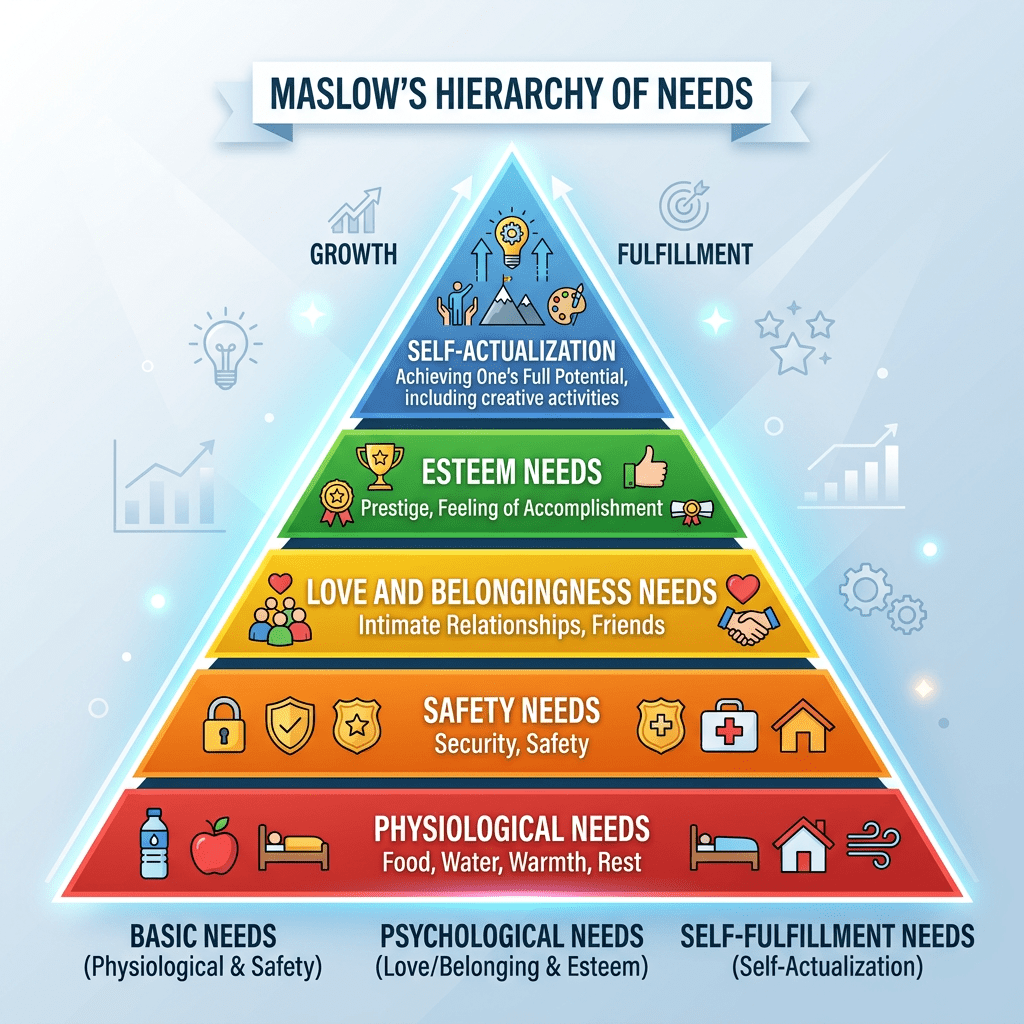
Maslow’s Hierarchy of Needs is a theory that suggests people need their basic needs met before they can learn effectively or reach their full potential. It’s often shown as a pyramid:
- Physiological needs – food, water, warmth, rest.
- Safety needs – feeling safe, secure and having predictable routines.
- Love and belonging – friendships, trusted adults, feeling accepted.
- Esteem – confidence, achievement, independence and praise.
- Self-actualisation – reaching your potential, creativity and personal growth.
Describe how external and internal impacts such as biology, environment, age, gender, nutrition, education and disability can impact on social behaviour.
Every student arrives at Forest School with their own experiences, strengths and challenges. Their social behaviour is influenced by a combination of internal factors, such as biology, age, disability and health, and external factors, including the environment, education, relationships and home life. As a Forest School practitioner working in a special educational needs (SEN) school, it is important to recognise these influences so that I can adapt activities, provide appropriate support and create an inclusive environment where every student has the opportunity to take part and celebrate success.
One of the biggest influences for my students is disability. Many of the young people I work with have autism, learning disabilities, communication difficulties and for a few, physical disabilities. These can affect how they communicate, understand social situations, regulate their emotions and respond to change. Some students may become anxious in unfamiliar situations, struggle to work alongside others or find it difficult to express their needs verbally. Others may require additional time to process instructions or need visual prompts and routines to feel secure. Understanding each student’s individual needs allows me to plan activities that are accessible and achievable while encouraging positive social interactions.
Biological factors can also influence behaviour. Every student develops at a different rate, and differences in brain development, sensory processing, hormones and physical health can affect how they respond to situations. Some students become overwhelmed by noise, movement or unexpected changes, while others actively seek sensory experiences. In Forest School, I can support these needs by providing calm spaces, allowing movement breaks, adapting activities and giving students time to regulate themselves before expecting them to participate.
The environment has a significant impact on behaviour. One of the reasons Forest School is so effective for many of my students is that the outdoor environment is often calmer and less restrictive than a classroom. Being surrounded by nature can reduce anxiety and improve emotional wellbeing. However, the environment can also present challenges. Cold weather, heavy rain, excessive heat or strong winds can make some students uncomfortable or dysregulated, which may affect their behaviour and willingness to engage. Equally, too much noise or overcrowding can increase anxiety. Good preparation, suitable clothing, shelter, flexible planning and adapting activities to suit the weather all help students remain comfortable and engaged.
Age and developmental stage should also be considered. Although some of my students are older teenagers or young adults, their communication, emotional regulation and social understanding may be very different from their chronological age. Activities therefore need to be matched to each student’s developmental level rather than simply their age. Providing achievable challenges helps build confidence while avoiding unnecessary frustration that could lead to disengagement or challenging behaviour.
Gender can influence behaviour, although every student should always be treated as an individual. Some students may have interests or previous experiences that affect the activities they choose or how confident they feel in group situations. Forest School encourages equality by offering open-ended activities where there is no right or wrong way to complete a task. This allows every student to participate according to their own interests, abilities and confidence rather than being limited by stereotypes.
Nutrition is another factor that can have a noticeable impact on behaviour. Students who are hungry, thirsty or tired often find it more difficult to concentrate, regulate their emotions and interact positively with others. Some students with additional needs may also have restricted diets or sensory sensitivities around food, which can affect their energy levels throughout the day. Before sessions I ensure students have access to drinking water, encourage regular hydration, and remain aware that changes in behaviour may sometimes be linked to basic physical needs rather than unwillingness to participate.
Education and previous experiences also shape social behaviour. Many of my students have experienced difficulties within traditional classroom settings or have previously struggled with confidence, communication or friendships. Forest School provides a different learning environment where success is measured through exploration, independence and personal achievement rather than academic performance. Students are encouraged to make choices, solve problems, take appropriate risks and work collaboratively. Over time, this helps develop resilience, confidence and positive relationships with both peers and adults.
As a Forest School practitioner, it is essential to recognise that behaviour is a form of communication. When a student displays behaviour that challenges, there is usually an underlying reason rather than simply poor behaviour. By observing students carefully, building trusting relationships and understanding the internal and external factors affecting them, I can adapt my approach to meet their individual needs. This creates a safe, supportive environment where students feel respected, valued and able to participate at their own pace.
Meeting students’ needs has a direct impact on their social behaviour. During one Forest School session, I changed the area we were working in after one student requested to work somewhere different. Although this met the needs of that individual, I quickly noticed that the change in environment affected some of the other students. The unfamiliar surroundings reduced their confidence and independence, and several students needed more reassurance and support than usual before they were willing to engage in activities. This reminded me how important familiar routines and environments are for many of my SEN students. It also reinforced the need to carefully consider the needs of the whole group and to introduce change gradually where possible, while providing additional support to help students feel safe and confident.
Overall, understanding the many factors that influence behaviour allows me to provide meaningful Forest School experiences that meet the needs of all my students, regardless of need. This is particularly important when working with students with special educational needs, as recognising individual differences enables every student to develop confidence, independence, communication skills and positive relationships.




 Forest Footsteps
Leave a comment