The Essential Guide to Forest School and Nature Pedagogy by Jon Cree 2021
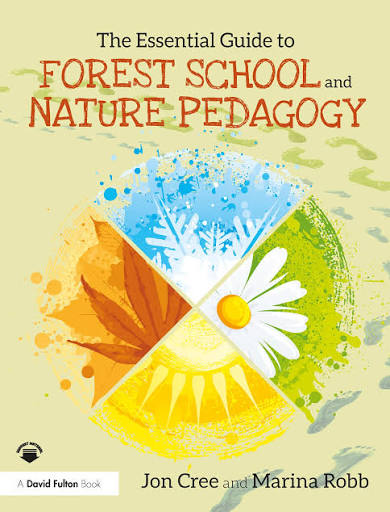
This book is not based on one specific research project. Instead, it brings together a range of existing research, educational theory and the authors’ own knowledge and experience of Forest School. I found it easy to read and understand, and it explains the principles of Forest School clearly. I found myself agreeing with many of the ideas because they reflected what I had already started to see during my own six-week Forest School programme. Reading the book helped me understand the theory behind why my students responded so positively to being outdoors.
The research is mainly desk-based, as the authors have reviewed existing research, educational literature, government guidance and Forest School practice rather than carrying out one new piece of research. They also include examples from their own professional experience and case studies to support their points.
The evidence presented is mainly qualitative. Although there are very few statistics, I found the real-life examples just as valuable because they helped me relate the research to my own students.
The main conclusion is that Forest School can have a positive impact on children’s and young people’s confidence, wellbeing, resilience, social skills, learning and connection with nature. This matched my own observations. Some of my students who were initially reluctant to explore or make decisions became much more confident by the end of the programme. They also began relying less on adults and started making more independent choices.However, the authors make it clear that these benefits come from high-quality Forest School practice delivered by well-trained practitioners over a sustained period of time, not simply from taking children outdoors.
Overall, I think the book is balanced. Although the authors are clearly passionate about Forest School and believe in its benefits, they also recognise that more high-quality research is needed to strengthen the evidence base. This makes me feel the information is fair rather than one-sided.
The authors recommend that more long-term research is carried out across a wider range of settings and participants. They also highlight the importance of ongoing professional development for Forest School leaders, maintaining the Forest School ethos, strengthening links between research and practice, and ensuring Forest School remains inclusive for all learners.
Before starting my Forest School qualification, I knew spending time outdoors benefited my students, but I could not always explain why. It supports giving students time to learn at their own pace, building confidence through repeated experiences, encouraging communication and social interaction, developing independence and problem-solving skills, and using nature to support emotional wellbeing. Although the book is not written specifically for SEN students, I feel the principles can be adapted very successfully for autistic students and those with complex learning needs. It has helped me understand why Forest School is such an effective approach for the students I work with and has reinforced many of the strategies I already use in my own practice.




Leave a Reply